Showing posts with label Museum Campus. Show all posts

America’s Courtyard


America’s Courtyard, 1998
Denise Milan and Ary Perez
Northerly Island
South of the Adler Planetarium                      
1300 South Lake Shore Drive

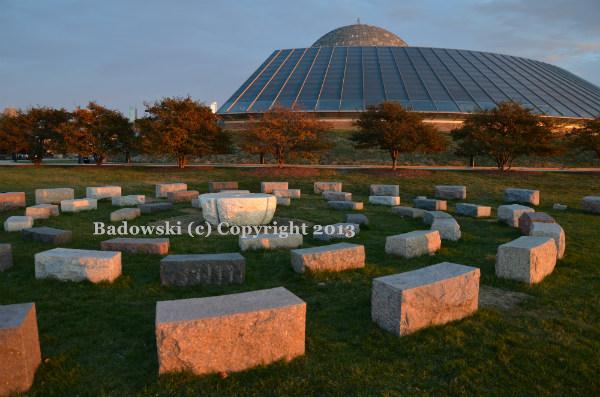
As part of the City of Chicago Public Art Collection, this work was originally installed near the Art Institute, but was relocated in December 2000.  In this location, the stone elements are configured to resemble a spiral galaxy and symbolizes an ancient celestial observatory. Astronomer Phyllis Pitluga helped the artists arrange the 56 granite pieces and four pieces of marble to create four pathways in a representation of the sun’s passage during the seasonal solstices. The spaces between the four stones align with the north-south and east-west compass points.

Balbo Monument


Balbo Monument, 1933
On lakefront bike trail, east of Soldier Field and north of McCormick Place and East Waldron Drive

During the 1933 Century of Progress World’s Fair, one of the highlights was an Italian squadron of 24 seaboats that landed in Lake Michigan near Navy Pier after flying 6,1000 from Ortobello. The airmen were lead by prominent fascist Italian aviator Italo Balbo who, according to the Daily News, was welcomed by large crowds who were “eager and ready” for a “twentieth-century version of Leonardo da Vinci.” Chicago renamed 7th Street Balbo Drive. 
As a gift for this gesture, Benito Mussolini sent a column, dating from the second century BCE to be placed in front of the Italian pavilion in the Century of Progress Exposition. The column once stood on the shore of the Mediterranean and now stands just a few feet from Lake Michigan, just north of McCormick Place near the bike trail. The original Italian inscription that mentioned Mussolini’s donation of the artifact had worn away by the mid-1960s and in the 1970s was repaired. However, in 1976, the Italian consul in Chicago pointed out to the park district that the re-engraving had misspellings. Today, even the repaired inscription has worn down to the point of being all but illegible.

Tribute to Freedom, Soldier Field Veterans Memorial


Tribute to Freedom, Soldier Field Veterans Memorial, 2003
Anna Koh Varilla and Jeffrey Hanson Varilla
Museum Campus
North end of Soldier Field
1410 S Museum Campus Drive

Originally called Municipal Grant Park Stadium when it opened in October 1924, it was renamed Soldier Field on November 11, 1925. The stadium was formally dedicated a year later during the Army vs. Navy football game as a memorial to American soldiers who had died in war. When the stadium was rebuilt to expand capacity in 2003, the exterior of the site was also enhanced and garnered with memorials to the men and women of the armed services. This includes a wall fountain at the north entrance as well as this statue crafted by the husband and wife team that form Koh-Varilla Guild. The couple specializes in classic realism and the figures on this 15-foot memorial represent Chicago’s ethnic and racial diversity.

Spiral Galaxy


Spiral Galaxy, 1994
John David Mooney
Northerly Island
South of Adler Planetarium
1300 South Lake Shore Drive

Originally commissioned by the Vatican Observatory in 1994, this 14-foot stainless steel sculpture was first presented to Chicago and installed at Navy Pier in 1998. It was later displayed in Sarasota, Florida along the bay. In 2005, as part of the celebration of the Adler Planetarium’s 75th anniversary, it was installed in its current location on the lawn just southwest of the museum. Specifically placed, the shadow of this work marks the winter and summer solstices on the northern ground plane. During the equinoxes, the shadow is east and west. The piece was inspired by early photographs of some of the Earth’s closest galaxies as well as Galileo’s drawings.
Another of Mooney’s large-scale works can be found in the atrium of the John Crerar Library at the University of Chicago. The aluminum and Waterford crystal work, Crystara, is considered by the artist to be his most complex and ambitious project. Mooney is the founder and artistic director of the foundation bearing his name, an organization that provides, among other things, a training program and a postgraduate study program for international artists and architects.

Man Enters the Cosmos (Sundial)


Man Enters the Cosmos (Sundial), 1980
Henry Moore
Northerly Island, northwest of Adler Planetarium

            Henry Moore (1898-1986), a British sculptor best known for his monumental abstract sculptures that draw visual analogies between the human body and landscape forms, made his first sundials between 1965-67. One was placed in the Printing House Square for the Times of London (later sold to IBM Corporation and placed at a location near Brussels). The sculpture consists of a thin bronze rod support by two intersecting bronze semicircles and the rod marks the time by casting a shadow on the ground. The 13-foot high Chicago sundial is nearly identical to the original one, with slight modifications. Moore added a golden patina to acknowledge the 50th anniversary of modern astronomy and had to adjust to sculpture itself to accommodate the ten degree difference in latitude between London and Chicago. The B. F. Ferguson Fund donated this work to the Chicago Park District and Moore worked with architects Hammond, Beeby, and Babka on the installation process.

Other works: