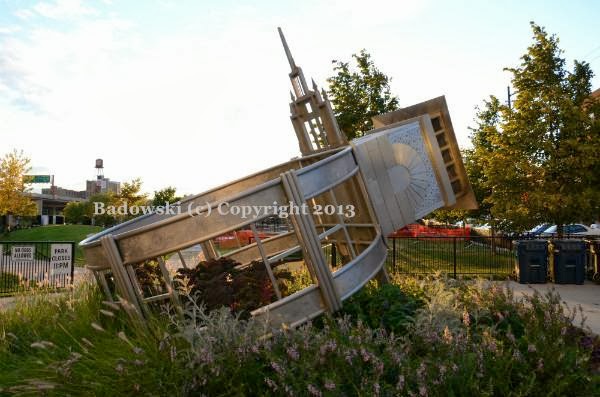
Commemorative Ground Ring


Commemorative Ground Ring, 1989
Shelia Klein
A. Montgomery Ward Park
South of West Erie and west of North Kingsbury Street

This stainless steel sculpture by Los Angeles artist Sheila Klein was part of the “Process Show” during Sculpture Chicago 1989, a now-defunct local non-profit organization that showcased public works at Riverfront Plaza by artists from around the world. Resembling a giant engagement ring, the piece incorporates features of the city’s architectural legacy, including a skyscraper, the three-part Chicago window, and the Getty Mausoleum by architect Louis Sullivan. Klein stated the sculpture was, “a tangible symbol of my love for Chicago architecture.”
At the conclusion of Sculpture Chicago 1989, the work was purchased by the Miro Fund specifically to be placed 
near the Chicago Historical Society (now called the Chicago History Museum). It was installed at the corner of West North Avenue and North Clark Street in 1990. (The Children’s Fountain by Robinson Iron is now in this location.) 
          When the museum made changes to the landscape in the mid-1990s, Commemorative Ground Ring was moved to a small north side park. When that park was renovated, the piece was put into storage by the Chicago Park District. It was finally retrieved and installed in 2005 in its current location in a park honoring  Aaron Montgomery Ward.

Unconditional Love


Unconditional Love, 1995
Lameck Bonjisi 
DuSable Museum of African American History
740 East 56th Place

            Born in Ruwa, Zimbabwe, Lameck Bonjisi (1973-2004) began sculpting by the age of 17 using rudimentary tools. In 1989 he approached Zimbabwe’s leading sculptor Nicholas Mukomberanwa (1940 - 2002) and was accepted as an assistant and apprentice to his workshop where he was guided for two years. 
          The distinct stylized lines in Lameck's sculptures show evidence of Mukomberanwa’s influence. Once Lameck began sculpting full time, he became an internationally respected sculptor with works shown at exhibitions around the world before dying of AIDS at age 31. 
          Lameck’s younger brother, Witness, studied with his brother as well as apprenticing with Mukomberanwa. His works are also exhibited worldwide. This opal stone sculpture is a gift from Sheila Handwerker to the museum.


Restoration


Restoration, 2007
Milton Mizenburg, Jr.
Williams-Davis Park
4101 South Lake Park Avenue

            Restoration is the first bronze sculpture by artist and activist Milton Mizenburg, Jr., who has been instrumental in bringing improvements to the Oakland community on the south side of Chicago. Mizenburg, a former forklift operator, moved to the neighborhood in 1988 with his wife Gloria and, initially, focused his energy on renovating his home and studio. Already experienced with crafting metal jewelry, Mizenburg began carving wooden sculptures and eventually adopted the chainsaw as his preferred tool. After improving his own home, the self-taught artist realized he could also improve some of the vacant lots near his house.  In 1996 he began using his chainsaw to craft tree stumps into abstract sculptures and dubbed the outdoor display the “Oakland Museum of Contemporary Art. Mizenburg has also inspired neighbors, such as Frank Duncan, to pursue their own dreams. Many of Mizenburg’s outdoor sculptures are displayed next to poems written by Duncan, a Vietnam veteran.
            In the late 1990s, the Chicago Housing Authority began work on their Plan for Transformation, which included razing the nearby deteriorating Lake Park Homes, a public housing project. The redesigned site includes a mixed-income community called “Lake Park Crescent” and the park where Mizenburg’s bronze work is located.

Carl von Linné Monument


Carl von Linné Monument, 1891 (relocated 1976)
Frithiof Kjellberg
Midway Plaisance
South of East 59th Street between South Ellis and South University Avenues

            This fifteen-foot tall bronze portrait of Swedish naturalist and botanist Carl von Linné (1707-1778) is a copy of a monument located in the Humlegarden in Stockholm. There has been confusion regarding the name of the sculptor, formerly listed as (Carl) Johan Dyfverman, as well as the intended meaning behind the four lost female allegorical figures. The Chicago Park District credits the piece to Frithiof Kjellberg (1836-1885) and the replica was unveiled on May 23, 1891 in Lincoln Park. The Swedish community of Chicago raised more than $18,000 to fund the project.
            Originally situated within an open green area in Lincoln Park, when the extension of Fullerton Avenue was completed in the 1940s, the statue found itself at the edge of the new roadway and it suffered repeated acts of vandalism. The female allegorical figures, which may have been muses to four branches of knowledge (philosophy, zoology, medicine, and geology) or representations of the four seasons, were repeatedly mutilated, resulting in the loss of some of their arms. During the early 1970s, the Central Swedish Committee proposed the idea of moving the monument to Midway Plaisance, despite protests from Lincoln Park citizens’ groups. The piece was moved in time for a visit from King Carl XVI Gustaf of Sweden to the University of Chicago in 1976 and he rededicated the monument. The four small platforms remain empty because the female forms, placed in storage as they awaited repair, have gone missing.
            Linné, known to science as Carolus Linneaus, was the first person to frame principles for defining natural genera and species of organisms and to create a uniform system for naming them. He is depicted in the outfit that he wore during his travels in the countryside and is holding a book, representing his numerous publications, and a flower that he discovered and named Linnaea borealis.

The Spirit of Du Sable Sculpture Garden


The Spirit of Du Sable Sculpture Garden
Ausbra Ford, Geraldine McCullough, Jill Parker, Ramon Berell Price, and Lawrence E. Taylor, 1978
The Du Sable Museum of African American History
740 East 56th Place near Cottage Grove

Co-founded in 1961 in the Bronzeville neighborhood by prominent artist, writer and activist Margaret Burroughs (1915-2010), the Du Sable Museum of African American History is the oldest museum in the United States showcasing African and African American history and culture. It moved into its present location in a former park administration building in Washington Park in 1971. The museum is named for Jean-Baptiste Pointe Du Sable, a Haitian of African and French descent considered to be the first permanent non-Indian settler in Chicago.
            In 1977, the Museum received a grant from the Community Development and Housing Committee to remodel the sunken garden north of the museum and to commission five artists to interpret the “spirit of Du Sable” in abstract sculptural forms. Unveiled and dedicated on September 22, 1978, the five works were to be maintained by the Chicago Park District and they joined a bronze bust of Du Sable by Robert Jones cast in 1971 and displayed outside the museum’s entrance.
            Unfortunately, in July and August of 1983, two of the works were stolen. The 6-foot tall, 200-pound bronze kneeling figure by Ramon Price, half-brother of then-Chicago Mayor Harold Washington, was severed from its cement pedestal in late July and, three weeks later, the bronze bust by Jones was removed from the front porch after thieves broke apart its hollow marble base. Additionally, the piece by Geraldine McCullough, created out of welded sheet copper, brass and polyester resin, has been damaged and is missing an upper portion intended to capture the “beauty of the waves of Lake Michigan.”
            The remaining intact pieces include Ford’s elongated square-headed human form made of sheet aluminum, which equates Du Sable’s strength with Chicago’s economic growth; Parker’s rectilinear work of stainless steel rods that surround solid blocks, which refer to three major periods in Chicago’s history that began with Du Sable’s settlement; and Taylor’s abstract curvilinear forms crafted from aluminum and stainless steel that suggest Chicago’s growth and continuing development.